G1/25: Enlarged Board of Appeal Narrows Requirement to Adapt Patent Descriptions After Claim Amendments
08 September 2026
The Enlarged Board of Appeal of the European Patent Office (EPO) has issued its long-awaited decision G 1/25 on 3 September 2026, clarifying when patent applicants and proprietors must adapt the description and drawings of a patent after amending the claims. We refer to our earlier articles of 16 March 2026 and 5 August 2025 on this subject.
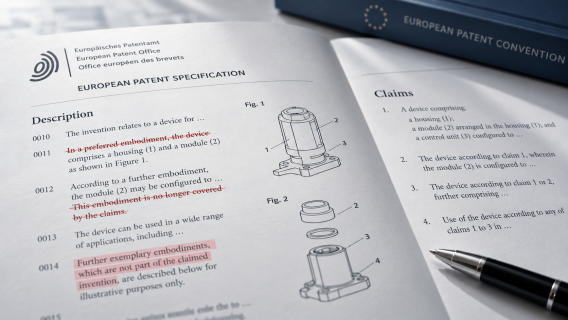
The decision resolves a long-running dispute in EPO case law and especially prosecution over whether descriptions must always be brought into conformity with amended claims. The Enlarged Board rejected both extremes: it neither endorsed an automatic “always adapt” requirement nor accepted that inconsistencies between claims and description are legally irrelevant.
Instead, the Board held that adaptation is required only where an inconsistency between the amended claims and the description or drawings results in non-compliance with a requirement of the European Patent Convention (EPC).
Importantly, the Board found that there is no single EPC provision that universally requires adaptation whenever claims are amended. Whether amendments to the description are necessary depends on the legal consequences of the inconsistency in the particular case. Relevant EPC provisions may include lack of clarity, as well as provisions concerning patentability, sufficiency, added matter and right to divisional applications.
The ruling builds on the Enlarged Board’s earlier decision G 1/24, reaffirming that the description and drawings must always be consulted for claim interpretation. As a result, passages in the description that create uncertainty about claim scope or affect the assessment of EPC requirements may still need to be amended or removed.
However, the Board expressly rejected a purely formal approach. It stated that Article 84 EPC does not require word-for-word correspondence between claims and description, and that passages lacking any legal significance need not be deleted merely because they are no longer covered by the claims.
The Board further confirmed that the same principles apply during both examination and opposition proceedings, including appeals.
The decision is expected to reduce the disputes over extensive description amendments before the EPO. Rather than requiring deletion or relabelling of embodiments no longer covered by the claims, EPO Examiners and Boards will need to identify a concrete EPC violation caused by the inconsistency. Applicants and patentees, meanwhile, will need to assess whether remaining text could influence claim interpretation or compliance with EPC requirements. Opponents are expected to also scrutinize description amendments to find points of attack. It will be interesting to see how quickly a consistent new EPO practice develops, and whether this opens new avenues for oppositions and litigation.
De Clercq & Partners is happy to assist you in determining whether this decision may affect your pending cases and how to best prepare. Please do not hesitate to contact us at info@dcp-ip.com.
DCPeloton returns from 29 March to 5 April 2027, bringing IP professionals from around the world together in Flanders for a unique week of cycling, professional connections and Belgian culture.
We are pleased to welcome Mathijs van Noort to De Clercq & Partners as a Patent Adviser / Trainee European Patent Attorney.
With his background in mathematics, engineering, computer science and AI, he will strengthen our Engineering, Software & AI team and contribute his expertise in areas including AI, software, IoT, medical devices, computer-implemented inventions, and various practical applications using software & AI.
We wish Mathijs a great start and look forward to working together!
Koen Vanhalst has once again been recognised in the IAM Strategy 300
We are pleased to announce that our partner Koen Vanhalst has once again been recognised in the IAM Strategy 300: The World’s Leading IP Strategists 2026.
The IAM Strategy 300 identifies leading professionals who are recognised for their ability to develop and implement strategies that maximise the value of intellectual property.
The New EU Regulation on New Genomic Technique (NGT) Plants: What It Means for Patenting Plants in Europe
On June 17, 2026, the European Parliament adopted Regulation (EU) 2026/1388 on plants obtained by New Genomic Techniques (NGTs), which entered into force on July 16, 2026.
Negotiations for this new EU Regulation began after a CJEU decision in 2018, which ruled that plants obtained through targeted mutagenesis (such as the CRISPR-Cas9 gene-editing technique) were captured by the Regulation on genetically modified organisms (GMOs) and all the strict requirements that entails, despite the fact that such NGT plants (cisgenesis and targeted mutagenesis) scientifically differ from traditional GMOs (transgenesis) in that they do not necessarily contain “foreign DNA”.